
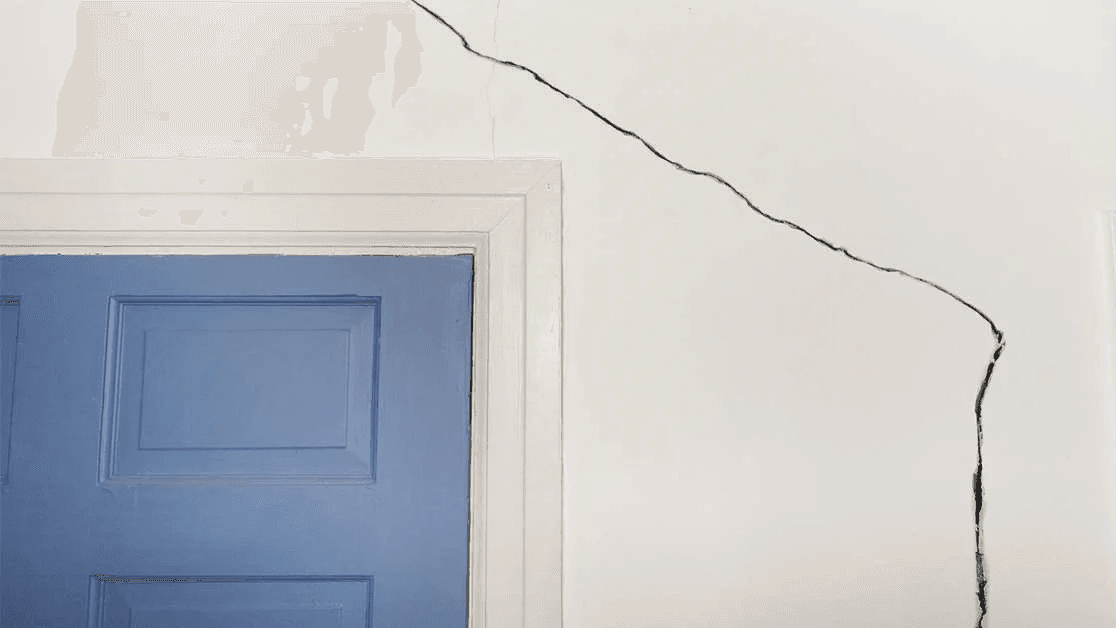
The three kinds of cracks, and what each one is telling you
Most cracks fall into three families. First, the diagonal cracks running from the corners of doors and windows: those corners are the weakest points in a wall, so when the frame racks even slightly, that's where the stress shows up. Second, long straight-line cracks, usually along a ceiling or down a wall at a suspiciously even height: that's a drywall seam where the tape has let go, a workmanship issue more than a structural one. Third, cracks that widen over time, run in stair-step patterns through a basement wall, or show up alongside doors that suddenly stick: those deserve more respect, and we'll get to them.
The Kansas City part: our soil moves more than most
A lot of the metro sits on expansive clay. Clay absorbs water and swells, dries out and shrinks, and Kansas City weather hands it both extremes every single year: soaked springs, baked summers. Your foundation rides on that soil, and the frame rides on the foundation, so the whole house breathes a little with the seasons. That's why the crack comes back in the same spot each year, often worst in late summer. The house isn't falling down. It's flexing, and the drywall is the first thing brittle enough to show it.
Why the quick patch always fails
Spackle and lightweight filler dry into a rigid little plug. Put a rigid plug in a joint that moves and the next season's movement cracks it right back open, sometimes with the patch outline visible around it. A repair that lasts looks different: the crack gets opened up and cut back to sound material, re-taped so the joint has tensile strength across it, filled with setting-type compound that cures hard, and feathered wide so the stress spreads across a foot of wall instead of a pencil line. For seams, the failed tape comes out entirely and gets replaced, because taping over loose tape just builds a taller failure. That's the difference between a patch and a repair, and it's why Ken's version doesn't reappear in March.
When a crack is more than a drywall problem
Here's the honest section. Some cracks are messengers, and Ken will tell you when yours is. The combination to take seriously: cracks that keep widening, stair-step cracking in basement block or brick, gaps opening between walls and floors or ceilings, multiple doors sticking at once, or floors that noticeably slope. That pattern points below the drywall, and the right next step is a foundation evaluation, not another coat of mud. Ken doesn't do foundation work and won't pretend to, but thirty years of running job sites means he knows the difference on sight, and he'd rather tell you the uncomfortable truth than sell you a pretty patch over a real problem.